On October 17, 1982, a routine drilling operation near the tiny hamlet of Lodgepole, Alberta, erupted into one of the province’s most harrowing industrial nightmares: the Amoco Dome Brazeau River 13-12-48-12 well blew out, spewing toxic hydrogen sulphide (H2S) into the air and igniting fires that would not be controlled for a full 68 days. What began as terrifying geyser of gas and flame quickly became a public-health crisis when plumes of H₂S drifted over towns and farmland. Thousands of people reported illness, and two workers lost their lives in the desperate efforts to regain control.
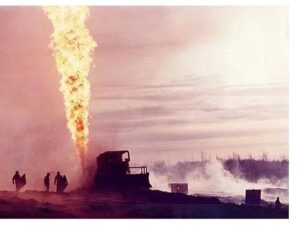
Amoco Dome Brazeau River 13 12 48 12 well blowout
Source: Edmonton Journal, https://edmontonjournal.com/news/local-news/dec-23-1982-lodgepole-sour-gas-well-blowout-finally-capped
The result of the emergency forced a stunned public and industry to confront the limits of existing emergency plans. The scale and complexity of the response, and the subsequent Lodgepole blowout inquiry, exposed glaring gaps in coordination, communication, and preparedness; its findings and recommendations prompted regulators and operators to adopt far more stringent emergency response procedures and industry recommended practices, including the creation of dedicated drilling and completions committees and formalized response protocols that reshaped sour gas operations across Alberta.
The image of drill pipe and equipment hurled from the well, heat blasted trees, and convoys of heat shielded tractors racing to shield crews became a searing symbol of why reactive improvisation could no longer suffice. After Lodgepole, emergency response planning moved from optional checklist to regulatory imperative, changing how oil and gas companies trained personnel, staged equipment, and coordinated with medical and municipal authorities for decades to come.
Directive 071: Emergency Preparedness and Response, is essentially the modern regulatory embodiment of the safety, communication, and emergency‑planning reforms demanded by the 1983 Lodgepole Inquiry. The Inquiry exposed major failures in sour‑gas emergency preparedness, public protection, and inter‑agency coordination. Directive 071 formalizes those exact gaps into enforceable requirements. On February 2, 2026, the AER will release the latest revisions to Directive 071 and the accompanying Manual 026: Emergency Preparedness and Response Guide. The following section outlines the most significant updates to Alberta’s emergency preparedness and response framework.
Growth in Regulatory Guidance
The modernization of Directive 071 expands the directive’s scope to cover all AER-regulated energy activities, aligns with national best practices (CSA Z246.2), and introduces a comprehensive, risk-based approach to emergency management. Extensive stakeholder feedback collected by the AER during consultation has informed updates to the regulation and directly addresses industry, public, and municipal concerns.
Key clauses from CSA Z246.2 have now been incorporated into the Directive which will modernize the regulatory requirements within Alberta by enforcing the implementation of a formal Emergency Management Program (EMP), improving corporate accountability, mandating use of the Incident Command Systems (ICS), and basing plans on a thorough hazard identification process.
Key Terminology and Scope Changes
The 2026 revisions significantly expand the scope and detail of both the directive and its guiding manual. This growth reflects a move towards more comprehensive and explicit requirements for emergency management. The number of primary sections in each document has notably increased, illustrating the depth of the new content. The primary driver for updating Directive 071 was the expansion of the AER’s mandate beyond traditional oil and gas; the new framework ensures all energy sectors are covered under a modern, consistent standard.
The AER now regulates all operations under the:
• Oil and Gas Conservation Act
• Oil Sands Conservation Act
• Pipeline Act
• Coal Conservation Act
• Geothermal Resource Development Act
• Mineral Resource Development Act
Mostly importantly, the new regulations now include all “applicable hazards that could result in an emergency requiring public safety and environmental protection measures, not just those from H2S and HVP products”.
Key terminology changes in the regulations include changing “Duty Holder” to “Approval Holder” to align with revised language in energy enactments. There is also the change from an “AER Approved ERP” to “Operation-Specific ERP” to clarify the new requirement for specific high-risk operations and a new requirement for a Corporate ERP by all Approval Holders.
Introducing the Emergency Management Program (EMP)
A cornerstone of the updated directive is the mandatory implementation of a comprehensive Emergency Management Program (EMP). This shifts the focus from simple response plans to a holistic, corporate-wide system for managing emergency preparedness, driven by senior management accountability.
Key Elements of the new EMP requirement include:
• A new ‘Emergency Management Program Declaration Form’ must be signed by senior management and submitted annually, addressing a previous gap in corporate accountability.
• Approval holders must appoint a EMP Program Coordinator responsible for the EMP’s development, implementation, and maintenance, providing a clear point of contact for the AER.
• A self-assessment must be conducted at least every five years using the new ‘EMP Self-Assessment Reporting Form’ to measure performance and ensure the program meets directive requirements.
• A formal Management of Change (MOC) process is now required to identify, review, and approve changes to the EMP, ensuring that plans remain current as operations evolve.
Shift to All-Hazards Identification & Consequence Analysis
The directive moves away from a primary focus on H₂S and HVP products to a risk-based ‘all-hazards’ approach. Approval holders must now conduct a formal Hazard Identification and Consequence Analysis (HICA) for all potential emergency scenarios related to their operations.
The analysis must cover a range of scenarios, including:
• Uncontrolled, unplanned, or accidental release of substances.
• Failure of structures or geological features.
• Natural hazard events affecting operational safety (e.g., wildfires, floods).
• Any other operation-specific emergency scenarios.
Another significant change is the introduction of the ‘Professional Declaration for Hazard Identification and Consequence Analysis’ form. This form requires a sign-off by a licensed professional registered with APEGA for:
• Scenarios that could result in catastrophic consequences to the public or environment.
• All EPZ determinations for H₂S and HVP operations.
Refined Public & Local Authority Engagement
Based on extensive feedback regarding resource constraints and ‘engagement fatigue,’ the requirements for engaging with the public and local authorities have been streamlined for greater efficiency and effectiveness. Key changes to public and local authority engagement includes:
• Engagement Frequency: The requirement for engaging with local authorities was changed from annually to at least once every 24 months, unless requested otherwise, to reduce the burden on municipal resources.
• Engagement Method: In-person engagement is now only mandatory for the initial development of a new operation-specific ERP. Subsequent engagements can use other methods like video conferencing, email, or telephone.
• Information Packages: A ‘Quick Guide to Emergencies’ must be created for Corporate ERPs and provided to the public or local authorities upon request. A more detailed Public Emergency Preparedness Information Package is required for all operation-specific ERPs.
• Ground Truthing: The requirement to conduct ground truthing every 12 months was maintained despite requests for extension, to mitigate the risk of missing new residents or developments within an EPZ.
• Emphasis on Synergy Groups: The 2026 Manual more strongly encourages the use of synergy groups as an efficient way to fulfill engagement obligations and reduce consultation fatigue for all stakeholders.
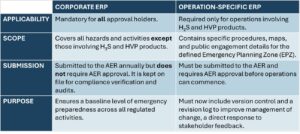
New Two-Tiered ERP Structure
The updated directive formalizes a two-tiered structure for Emergency Response Plans (ERPs), distinguishing between a comprehensive corporate-level plan and plans for specific high-risk operations.
Plans will also require updating to the revised version of the Assessment Matrix for Incident Classification.
Strengthened Training and Exercise Requirements
Emergency Management Training
The 2026 Directive mandates the use of the Incident Command System (ICS). Although neither the Directive nor the Manual explicitly references ICS training, approval holders will likely need to ensure all response personnel receive appropriate ICS instruction to meet the requirement for its use. The updated Directive also introduces more rigorous expectations for establishing and managing a formal emergency management training program, including the development and maintenance of comprehensive training plans.
Spill response equipment training requirements have now been moved into the main ‘Training’ section, separating it from the ‘Spill Contingency Planning’ section. It maintains the allowance for members of a spill cooperative to meet requirements by participating in the co-op’s exercises but clarifies the options more distinctly.
Emergency Exercises
The 2026 Directive strengthens the requirements for exercises to ensure they are more effective and promote continual improvement. Key changes to exercises include:
• Corporate ERPs (without Operation-Specific ERP): The 2026 version introduces a new requirement to hold a major exercise every 5 years for corporate ERPs; this was not explicitly required in the 2023 version.
• Operation-Specific ERPs: The frequency remains every 3 years, but the 2026 version clarifies it must be held in the first year of implementation.
• Joint Exercises: The 2026 rules provide more specific criteria for joint exercises conducted by synergy or mutual aid groups, requiring they be a ‘major exercise’ and that the local authority and Alberta Emergency Management Agency (AEMA) must be invited.
• Maturity of Exercises: the new directive changes the annual requirement to conduct a communications exercise or tabletop exercise, to a tabletop or functional exercise, demonstrating a desire for approval holders to conduct more mature exercises.
• Increased Corporate Involvement: Major exercises must now include all levels of the organization, including senior management which they define as “persons (e.g., chief executive officer, president, board member, or director) with authority to influence the direction and culture of the organization”.
Quick Overview of Requirements
Curious whether your organization meets the new compliance standards? Review the checklist below to see how you measure up.
1. Emergency Management Program (EMP) – New Mandatory Framework
☐ Establish a formal, corporate-wide Emergency Management Program (EMP)
• Implement a documented EMP covering preparedness, response, recovery, and continual improvement.
• Shift from plan-centric compliance to program-centric compliance.
☐ Submit an annual EMP Declaration Form
• Signed by senior management.
• Addresses a new accountability requirement.
☐ Appoint an EMP Program Coordinator
• Named individual responsible for development, maintenance, and implementation.
• Formal point of contact with AER.
☐ Conduct a 5-year EMP Self-Assessment
• Use the new EMP Self-Assessment Reporting Form.
• Document program maturity and compliance status.
☐ Implement a formal Management of Change (MOC) process for the EMP
• Required to review and approve changes as operations evolve.
• Must be auditable.
2. All-Hazards Identification & Consequence Analysis (HICA) – Expanded Scope
☐ Conduct a formal Hazard Identification and Consequence Analysis (HICA)
• Must cover all applicable operational hazards, not only H₂S or HVP. This includes:
o Accidental or uncontrolled releases
o Structural or geological failures
o Natural hazards (e.g., wildfire, flood)
o Operation-specific emergencies
☐ Complete a Professional Declaration for HICA
• Required sign-off by a licensed APEGA professional for:
o Scenarios with catastrophic public or environmental impact
o All EPZ determinations for H₂S and HVP operations
3. Two-Tier ERP Structure – New Mandatory Architecture
☐ Develop and maintain a Corporate ERP
• Required for all approval holders.
• Must align with the corporate EMP.
☐ Develop Operation-Specific ERPs for high-risk operations (HVP and H2S operations only)
• Replaces the former “AER-approved ERP” model.
• Plans must be risk-based and scenario-specific.
☐ Update all ERPs to the revised Incident Classification Matrix
• Mandatory alignment with the new assessment matrix.
4. Public & Local Authority Engagement – Refined Requirements
☐ Adjust engagement frequency with local authorities
• Now at least once every 24 months (not annually), unless otherwise requested.
☐ Conduct in-person engagement only for initial ERP development
• Subsequent engagement may be virtual, email, or phone.
☐ Develop a “Quick Guide to Emergencies” for Corporate ERPs
• Must be available upon request.
☐ Develop a Public Emergency Preparedness Information Package
• Required for all Operation-Specific ERPs.
☐ Maintain annual ground-truthing within EPZs
• 12-month frequency retained.
• Used to capture new residents or developments.
☐ Leverage synergy groups for engagement
• Stronger encouragement to reduce stakeholder fatigue.
• Recognized compliance pathway.
5. Incident Command System (ICS) – New Mandatory Use
☐ Implement ICS as the response management framework
• Mandatory operational requirement.
• Implied need for ICS training across response personnel.
☐ Align training programs with ICS usage
• Training plans must demonstrate ICS competency.
• Not optional under the new directive.
6. Emergency Management Training – Strengthened Governance
☐ Establish a formal emergency management training program
• Documented training plans required.
• Corporate-level accountability.
☐ Relocate spill response training into the main training framework
• No longer treated as a standalone requirement.
• Clarifies cooperative training equivalency.
7. Emergency Exercises – New Frequencies and Scope
☐ Conduct a major exercise every 5 years for Corporate ERPs
• New requirement; not explicit in the 2023 directive.
☐ Conduct Operation-Specific ERP exercises in Year 1 of implementation
• Frequency remains every 3 years.
• New clarification added.
☐ Conduct more mature exercise types annually
• Tabletop or functional exercises now expected.
• Communications-only exercises no longer sufficient.
☐ Include senior management in major exercises
• New explicit expectation.
• Applies to corporate-level events.
☐ Meet new criteria for joint exercises (synergy/mutual aid)
• Must be a major exercise.
• Local authority and AEMA must be invited.
8. Terminology & Regulatory Scope – Structural Compliance Changes
☐ Replace “Duty Holder” with “Approval Holder” in all documentation
• Mandatory terminology alignment.
☐ Transition from “AER-approved ERP” to Operation-Specific ERP
• Reflects new two-tier ERP architecture.
☐ Expand compliance to all AER-regulated sectors
• Includes Oil Sands, Pipelines, Coal, Geothermal, Mineral Resources.
Supporting Your Transition to the Updated Requirements
The revised directive includes several additional updates that were not covered in this article. The 2026 Directive, Manual, and related forms are available on the Alberta Energy Regulator’s website, and anyone subject to the new requirements is strongly encouraged to review them. If your organization needs support integrating these new requirements into your Emergency Management Program, Sandhurst Consulting is ready to assist with program development, updates, training, and implementation.