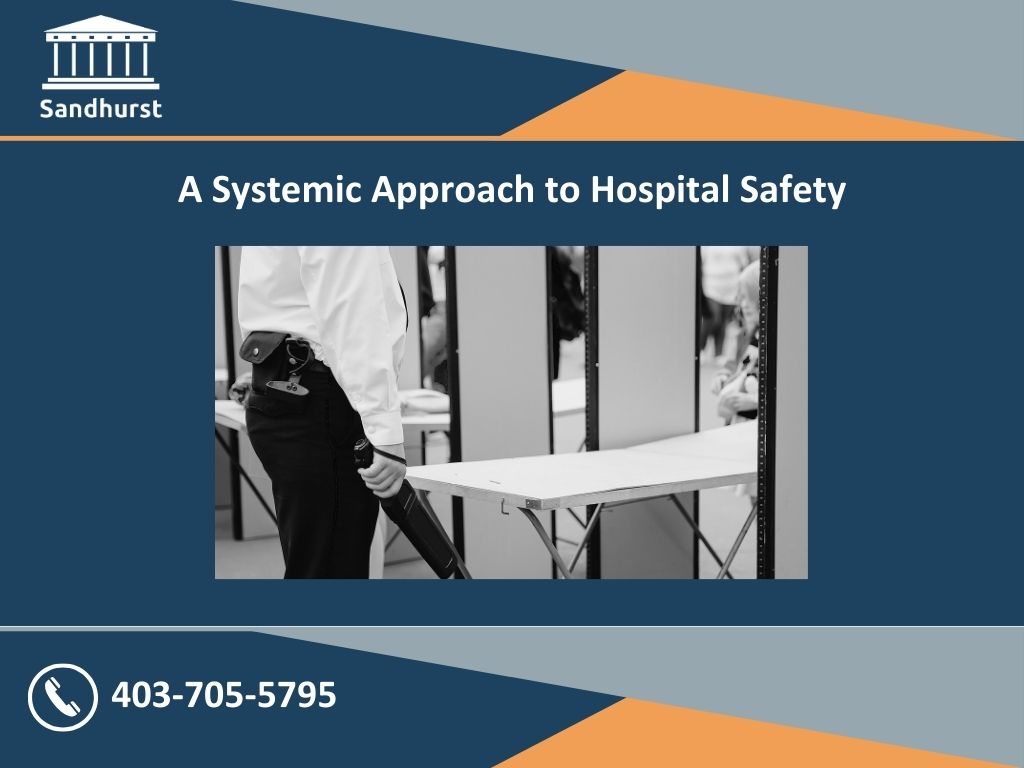
Last week’s announcement from the Saskatchewan Health Authority that metal detectors are already intercepting knives and weapons in Saskatoon and Regina hospitals shouldn’t surprise anyone working in Emergency Management or Security. These devices do what they are designed to do, but the real risk lies in treating them as a solution rather than a single control within a much larger system. From our perspective, this moment matters not because of the technology itself, but because it exposes deeper structural issues in how hospitals manage risk, response, and accountability.

Photo: Weapons and other items were gathered at Saskatoon’s St. Paul’s Hospital prior to the installation of metal detectors. (Courtesy: Saskatchewan NDP)
Early results from the detectors are predictable: weapons are being intercepted, some individuals choose not to enter when deterrence is visible, and front-line staff experience a modest but immediate sense of relief. All of that is positive. But metal detectors only address one narrow threat vector, concealed weapons entering through monitored access points. They do nothing to mitigate escalating behaviour already inside the facility, non-metal or improvised weapons, delayed police response in rural or northern hospitals, or the challenges created by poorly trained or unsupported security staff. More importantly, they cannot compensate for systemic pressures such as overcrowding, long wait times, or mental health crises. This is mitigation without preparedness or response maturity.
The more serious concern is the fragmented nature of hospital security itself. Reporting has already highlighted several red flags including:
- An absence of a clear timeline or scope for the independent review.
- A lack of consultation with unions and frontline staff.
- Inconsistent deployment across facilities.
- Over-reliance on third‑party security in some regions.
- Troubling incidents involving use of force, misidentification, and cultural harm.

The real risk: fragmented security without command and control
These issues point to a governance problem, not a personnel problem. Hospitals are now functioning as high‑risk public safety environments, yet many are still managed as though violence is an anomaly rather than a predictable operational reality.
If Saskatchewan, or any jurisdiction, wants meaningful improvement, the path forward requires more than additional hardware. Hospital security must be treated as an incident management function, operating under a clear command framework with defined authority, escalation triggers, decision rights, and integration with clinical leadership. Reporting, documentation, and afteraction reviews must be standardized, and when force is used, accountability must rest with command structures rather than individual guards.
Professionalize healthcare security training
Professionalizing healthcare security training is equally essential. Security officers in hospitals face unique challenges and must be trained to manage the operational complexities of their environment including:
- Deescalation in the context of intoxication or mental health crises.
- Decisionmaking under stress and appropriate use-of-force.
- Cultural safety and Indigenousled awareness.
- Communicating and coordinating with clinical staff and police.
If they are the first responders to violence, they must be trained like first responders.

Design layered security, not single points of failure
Hospitals also need layered security rather than single points of failure. Controlled access, internal zoning, duress alarms (especially in rural sites), real‑time CCTV monitoring, and shared behavioural threat indicators all contribute to a more resilient system. Metal detectors are only one layer, and not the most important one.
Response failures are often demand failures
Addressing the upstream drivers of violence is equally critical. Overcrowded emergency rooms, insufficient detox capacity, and staffing shortages create longer waits, heightened stress, and more frequent confrontations. Security ends up absorbing the consequences of operational pressures it does not control. Reducing violence requires operational fixes, not just security fixes.
Any review of hospital security must be public, timebound, and accountable. Frontline staff and unions need to be central contributors. Milestones must be clear, reporting must be transparent, and responsibility for implementing recommendations must be explicitly assigned. Without this, the review risks becoming another well intentioned document that quietly fades away.
Final thought: deterrence is easy, resilience is harder
Metal detectors are visible. They photograph well. They send a message. But safety is a capability, not a symbol. If emergency departments are now places where weapons, violence, and crisis intersect, they must be managed with the same seriousness applied to major events, critical infrastructure, and public safety operations. Anything less leaves staff exposed, patients at risk, and leadership reacting instead of leading. This is the moment to shift from reactive security to intentional security and emergency management, and that requires far more than metal detectors at the door.
Reach out to discuss your business risk potential from public access and what can be done to protect your workplace and people.