Lance Bushie | Senior Associate, Emergency Management and Leadership
Wildfire response planning in Canada has long centred on early, orderly evacuation and for good reason. Removing people from the hazard zone is almost always the most effective way to reduce exposure to fire, smoke, and infrastructure failure. But real‑world events continue to show that evacuation is not always possible. Roads close unexpectedly, visibility collapses, traffic stalls, and fire behaviour can shift faster than a community can move. When these conditions emerge, communities need a credible, pre‑planned alternative that protects life when evacuation becomes the greater hazard. The operational question is clear: What should a community do when evacuation is no longer the safest option?
This is where shelter‑in‑place and designated refuge points must be treated as essential components of a layered life‑safety system, not just as improvised last resorts. Our work in fire and emergency management has taught us that plans fail at their assumptions. The assumption that everyone can always leave is particularly dangerous. At Sandhurst, our intent is not to replace evacuation with shelter-in-place. It is to ensure that Canadian communities plan for evacuation, temporary refuge and hardened shelter as connected systems of redundancy.
Lessons from Recent Wildfires
The recent (July 2026) wildfire near Bédar, Spain, illustrates the consequences of assuming evacuation will always remain viable. Several victims reportedly left the designated route and were overtaken by the fire, while others survived because authorities instructed them to remain indoors when the fire was already too close to outrun.
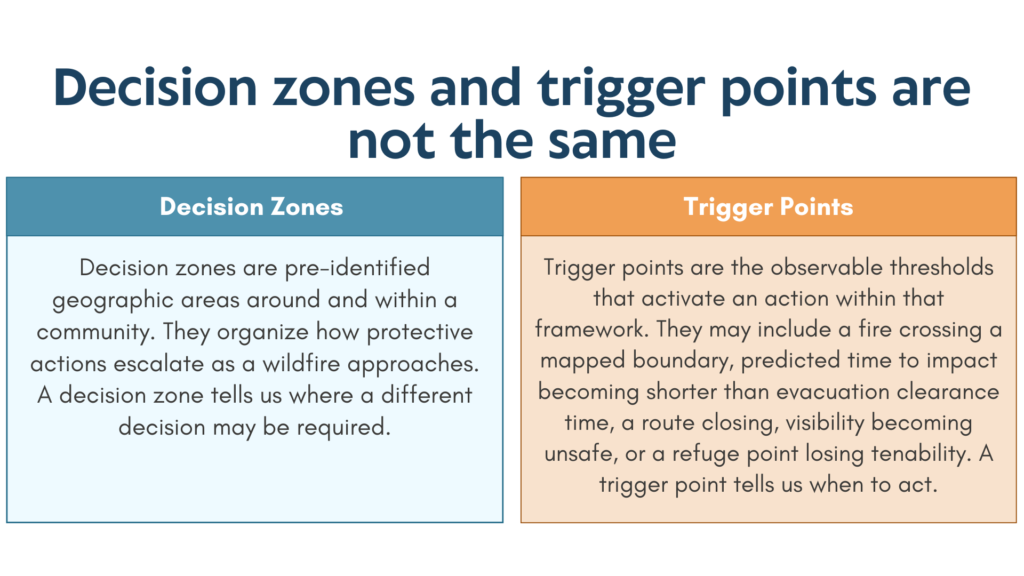
During the 2018 Camp Fire, roads closed, traffic became impassable and civilians experienced multiple burnovers. The National Institute of Standards and Technology (NIST) identified 31 temporary refuge areas used by more than 1,200 civilians; with some being improvised under extreme conditions. Their use demonstrated both the life-saving potential of refuge and the danger of waiting until the fire arrives to identify it. The NIST now recommends decision zones and pre-designated Temporary Fire Refuge Areas be incorporated into emergency planning. As a fire approaches successive zones, the strategy changes to evacuating while time and route capacity permit, redirecting people if a route becomes threatened, and moving people to nearby refuge when continued evacuation becomes more dangerous. Peer-reviewed research involving Camp Fire evacuees also found that pre-planning routes and destinations was associated with greater perceived safety.
Lahaina reinforces the systems lesson. Research involving 657 survivors found that 93% did not receive an official alert as their first information; many relied on environmental cues, neighbours and informal messages. The independent Lahaina investigation recommended multiple warning methods, primary and alternate routes, traffic-management plans, accessible gates, drills, and specific support for people with access and functional needs. While refuge cannot compensate for late warning, it is the contingency that remains when evacuation systems are disrupted or overtaken.
Understanding When to Evacuate, When to Seek Refuge, and When to Shelter
Sheltering, or moving to a designated refuge point, should be considered when a community cannot complete evacuate before fire reaches the routes, when smoke, debris, downed power lines or collisions make travel unsafe, or when routes are blocked or overwhelmed. It is also appropriate when the fire arrives with little warning, when moving people with access or functional needs would create more risk than remaining in an assessed facility, or when a short movement to a refuge point is safer than attempting to leave the community. Early evacuation remains the preferred action when time, open routes, transportation, and safe destinations are available. Wherever possible, authorities, not residents, should make and communicate this decision.
Evacuation is often used as the default because it removes people from the wildfire, smoke, and infrastructure failures without relying on an ordinary building to withstand unknown fire exposure. It is also familiar to both authorities and the public; however, its weakness is the assumption that warning time, road capacity, and transportation will always be sufficient. Communities with limited routes may be unable to move their entire population before a fast‑moving fire affects the road network. While early evacuation should always remain the primary strategy, refuge should be added as a planned contingency.
A Three‑Part Framework
The following actions require predetermined triggers based on predicted fire behaviour, time to impact, evacuation clearance time, road status, smoke, route capacity and refuge tenability. Authorities should communicate both the transition and the safest available route wherever possible.
First: Evacuate
Use evacuation when there is enough time, the route and destination are tenable, traffic can be managed, and transportation is available for the whole population, including visitors and people requiring assistance. If evacuation is recommended, evacuation orders must include route information. Communities need coordinated, multilingual, accessible messaging delivered through multiple channels (mobile alerts, radio, sirens, social media, signage, and door‑to‑door notification). Updates must reach people already on the move, not just those still at home.
Second: Move to a designated refuge point
Use a refuge point when the community cannot complete evacuation before fire affects the routes, visibility is unsafe, egress is blocked, or a short movement to an assessed location is safer than a long movement through the hazard.
Third: Shelter in a hardened building
Use hardened shelter only when movement is more dangerous and the building has been assessed for the expected exposure. This is a last-resort action or a deliberately engineered option for facilities that cannot evacuate quickly. It is not “stay and defend,” and an ordinary house should not be assumed survivable.
Designing refuge points that communities can rely on
A credible wildfire refuge is one that has been deliberately selected, assessed, and prepared to protect people during the most dangerous period of a fire; it must be evaluated and engineered to protect people when evacuation is no longer safe. It can be a hardened community centre or school, or an assessed open area such as a sports field, parking lot, or golf course. Simply marking a location on a map is not enough, the site must demonstrate real, measurable survivability.
To be considered credible, a refuge point must have:
- Adequate separation from hazards, including vegetation, nearby structures, hazardous materials, power lines, and sources of radiant heat.
- Sufficient capacity and accessible entry, ensuring all residents, including those with functional needs, can reach and use the site safely.
- Reliable communications, so responders can coordinate and the public can receive updates.
- Trained personnel and accountability systems, ensuring the site is managed effectively during peak fire conditions.
- Basic life‑safety supplies, appropriate for short‑duration protection.
Enclosed refuge buildings require additional safeguards including smoke protection, effective air filtration, backup power, and contingency plans for mechanical‑system failure.
Credibility also depends on interdisciplinary assessment. Wildfire specialists, fire‑service personnel, building experts, and emergency‑management professionals should evaluate sites together to ensure they meet exposure and operational requirements. Lastly, the public must know where refuge points are located and practice reaching them. Refuge is a temporary life‑safety measure. It protects people through peak exposure until evacuation or rescue becomes possible, but it is not a reception centre or a substitute for early evacuation.
Our recommendation for Canadian communities
At Sandhurst, we recommend that every wildfire plan clearly identify the point at which evacuation may no longer be the safest option. To do this, emergency managers should map decision zones, assign trigger points to specific protective actions, calculate evacuation clearance times under realistic traffic conditions, assess and maintain refuge points, establish redundant alerting systems, maintain live fire and road intelligence, plan for residents without vehicles, and routinely exercise both route communication and transitions between protective actions.
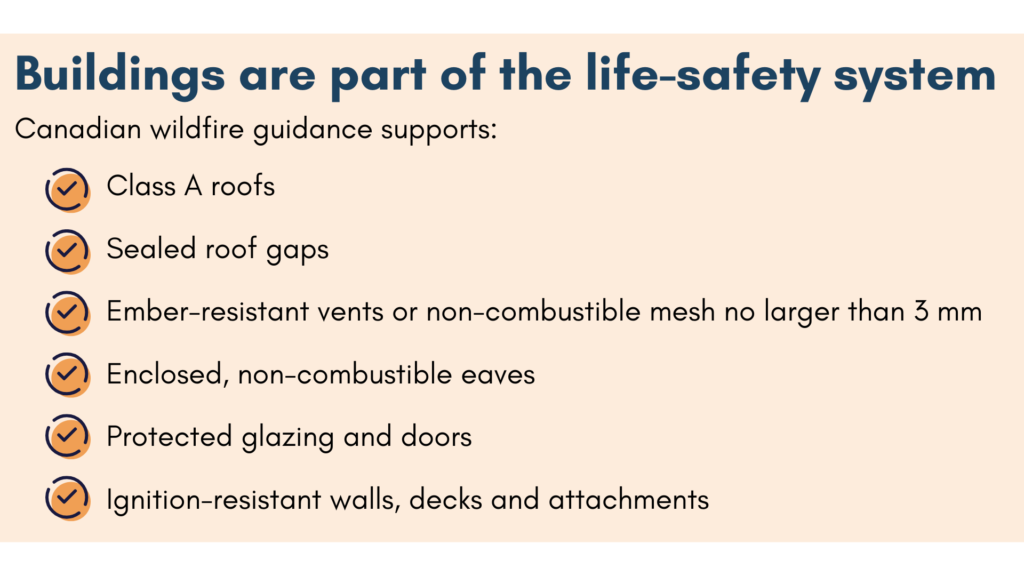
Equally important is the use of wildfire‑resistant construction and FireSmart fundamentals to reduce the risk of ignition from embers, direct flame, and radiant heat. In communities with a high wildland-urban interface, the first 1.5 metres around a building should be completely non‑combustible, with vegetation, mulch, stored materials, and wooden fencing removed. From 1.5 to 10 metres, fuels should be carefully thinned and consistently maintained to limit fire intensity. Any building designated as a refuge must go further, incorporating exposure‑specific engineering, protected utilities, backup power, smoke‑management systems, and adequate separation from neighbouring structures.
The recent fires in Spain, Paradise, and Lahaina reinforce a critical lesson: the goal is not to replace evacuation with shelter. Timing and tenability determine which action is safest. Early evacuation saves lives, but a well‑designed refuge strategy can also save lives when evacuation becomes impossible. Communities must be prepared for both. We should not expect the public to invent a third option in the moment the fire arrives.
Sources and further reading
Bénichou, N., et al. (2021). National guide for wildland-urban interface fires. National Research Council Canada.
Chen, C., Zhang, C., Lindell, M. K., Wang, Y., Qiu, Q., Wang, H., & Zhang, G. (2025). Alerts and warnings under disrupted communication infrastructure: Lahaina residents’ immediate responses to the 2023 wildfire. International Journal of Disaster Risk Reduction, 131, 105884.
Euronews. (2026, July 10). Spain wildfire victims appeared to abandon evacuation route.
Fire Safety Research Institute. (2024). Lahaina fire incident analysis report: Findings and recommendations. Hawaiʻi Department of the Attorney General.
Grajdura, S., & Rowangould, D. (2025). Understanding wildfire evacuees’ perceived safety on their evacuation route: A study of the 2018 Camp Fire. Transportation Research Interdisciplinary Perspectives, 31, 101392.
Maranghides, A., & Link, E. (2025). WUI fire evacuation and sheltering considerations: Assessment, planning, and execution (ESCAPE). National Institute of Standards and Technology.
Maranghides, A., Link, E., Mell, W., Hawks, S., Brown, C., & Walton, W. (2023). A case study of the Camp Fire—Notification, evacuation, traffic, and temporary refuge areas (NETTRA). National Institute of Standards and Technology.